
Viktor Orban risks losing power in Hungary, but will fight desperately to retain it
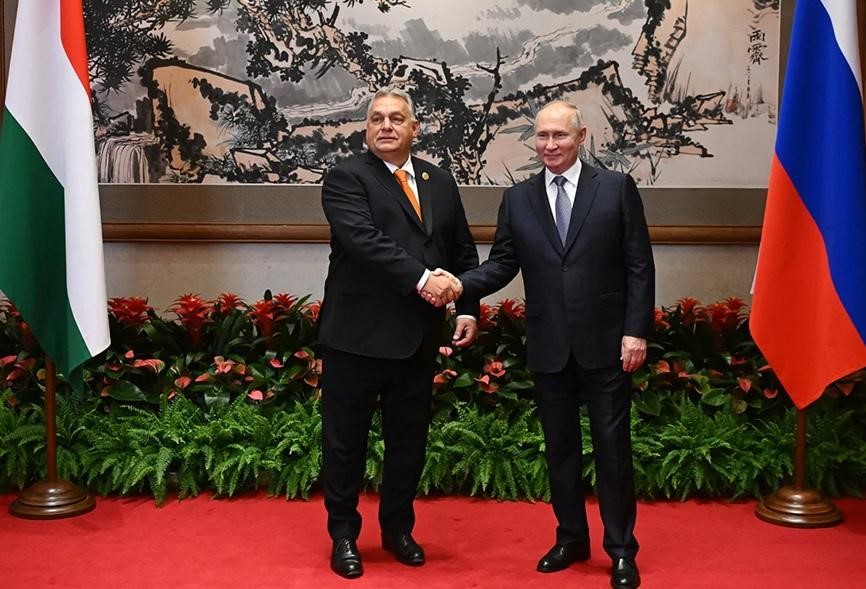
For the first time since 1998, Hungary’s Prime Minister, Viktor Orban, has had a risk of losing power, and, perhaps, freedom. According to recent polls, the opposition in Hungary ratings rasing from a few percentage points to more than 15% to the Orban’s FIDEZ. Hungary’s parliamentary elections are just weeks away. The vote is scheduled for April 12. It’s no coincidence that Viktor Orban calls them fateful even as he as usual finds the enemy. This election campaign the enemy is Ukraine. Orban declared that Hungary becomes a “colony of Ukraine” and threatening the electorate with the possibility of Hungary being drawn into a war with Russia without him. For Hungary’s longtime leader, these elections could be fatal: if he loses, he could face anti-corruption investigations.
Contents:
• Orban’s Evolution
• The Economic Preconditions of the Orban’s empowerment
• Does Putin Have Compromising Information on Orban?
• Kremlin and Orbán Coordination for Election Victory
• Brief Conclusions
• Additional Information
Orbán’s Evolution
Viktor Orbán began his political career in the late 1980s in Hungary, which had just emerged from the Soviet Union. At that time, Orbán was a pro-Western, democratically oriented liberal and received a scholarship from the Soros Foundation. In 1998, Orbán became Hungary’s prime minister for the first time. His subsequent evolution took place within the European space. Hungary joined the EU in 2004, between Orbán’s first and second terms as prime minister (his second, ongoing, term began in 2010).
Between 2000 and 2010, Orbán reoriented his Fidesz party from liberal to right-wing conservative positions, which caused a split and the exodus of its co-founders. During his second term as prime minister, Orbán’s policies changed decisively: from a liberal and pro-EU figure, he gradually transformed into a conservative and Eurosceptic, the Kremlin’s main ally within the EU.
In 2010, the FIDESZ party held a constitutional majority in the Hungarian parliament, and Orbán implemented constitutional reforms, including strengthening the executive branch’s influence over the judiciary. In a 2012 report, Human Rights Watch warned that these changes would “weaken judicial oversight over the government, undermine media freedom, and otherwise jeopardize human rights protections in the country.” Orbán also gained control of 80% of Hungary’s largest media outlets through political and economic manipulation and corporate takeovers by friendly oligarchs. Vladimir Putin had acted similarly in Russia 10 years before Orbán in Hungary.
As a result, Viktor Orbán built an authoritarian regime in Hungary, based on corruption, subjugation of the judiciary, and control of key media outlets. Orbán seems to have copied some steps aimed at maintaining his personal power—for example, the Hungarian legislative initiative on foreign agents—from Russian Putinist practices. Orbán and other Hungarian politicians regularly oppose anti-Russian sanctions and even sabotage their adoption. However, his disregard for democratic norms has earned Orbán a completely different kind of attention: the EU periodically withholds billions of euros from European budgets owed to Hungary due to violations of the rule of law.
Russia’s full-scale invasion of Ukraine in 2022 had no impact on relations between Orbán and Putin. Although it publicly condemned the war, Budapest did not provide Ukraine with significant military or humanitarian aid. Two days before Russia’s full-scale invasion of Ukraine, Hungary began redeploying its army to the border with Ukraine. Orbán may have been counting on the rapid collapse of Ukrainian statehood and the territorial disintegration of Ukraine, planning to occupy ethnic Hungarian-populated Ukrainian territories under the pretext of population security, with the goal of subsequently creating a controlled territorial entity.
In 2026, the Washington Post reported, citing sources, that European intelligence agencies were aware that Hungarian Foreign Minister Szijjártó regularly secretly passed information on meetings to Sergey Lavrov directly from EU meetings. During breaks the Hungarian official called to Moscow and shared details of the negotiations and discussions.
The true scale of the secret cooperation between Russian officials and intelligence agencies and the Orbán government is still difficult to assess.
The Economic Preconditions of the Regime
The economic foundation of Orbán’s rule is the concentration of power and the accumulation of personal wealth, achieved bloodlessly through state coercion. This vast network, based on patronage, was capable of enabling Orbán’s seizure of power. Companies associated with Orbán and the Fidesz party regularly receive government contracts; estimates suggest that in some industries, the share of companies associated with Orbán and his associates exceeds 70%.
Lorenz Mészáros, Hungary’s richest man and the largest recipient of government contracts in Hungary, is a longtime friend of Hungarian Prime Minister Viktor Orbán. The bulk of his capital comes from the gas company Meszáros & Meszáros, which receives gas from Russia. Symbolically, Mészáros is also the head of the administration of Orbán’s home village, where he is building premium infrastructure. This practice of “social burdening,” i.e., the development of living and recreational spaces for Russian leaders by business associates, is also common in Russia. For example, Putin’s Gelendzhik palace, famously reported by Navalny and valued at over $1 billion, was built by close business associates using profits from government contracts and, according to documents, does not belong to Putin personally.
In the same village where Orbán is born, there is a former Habsburg estate, now owned by the prime minister’s father, Gyözsö Orbán. After extensive renovations, the complex includes gardens, swimming pools, greenhouses, and luxurious buildings. The Hungarian prime minister denies that the palace complex belongs to him. Istvan Tiborcz, Viktor Orbán’s son-in-law, has also been mentioned among Hungary’s richest people.
The concentration of the country’s economic resources in the hands of those close to the leader also resembles the structure of the Russian economy. The country’s wealthiest individuals effectively serve as the political leader’s “wallet holders,” enjoying uncompetitive advantages in the economy and, in return, providing for the leader’s personal expenses and shadow financing for maintaining power in the country.
Similar economic mechanisms for seizing power are also supported by Russia. On December 8, 2014, Russia’s Rosatom and Hungary signed documents for the construction of the fifth and sixth units of the Paks Nuclear Power Plant, which will use reactors using Russian VVER-1200 technology. The project cost approximately $14.7 billion, 80% of which is covered by a Russian loan. Construction work began after 2019, and the contractor is the Hungarian state-owned company MVM Group, controlled by Viktor Orbán.
Construction documentation is classified under the pretext of security, creating ample opportunities for corruption, inflated costs, and the redistribution of these funds to Orbán’s benefit. The Paks II nuclear power plant project is currently under development, and is being called corrupt due to the closed nature of the deal, the lack of a transparent tender, and the huge Russian loan (€10 billion+), which is prompting EU investigations. This project could also become a tool for Russia’s political influence over Hungary.
In 2021, Hungary signed long-term contracts for Russian gas supplies, which continue to allow it to receive fuel at a five-times lower price than the market price. The contracts run until 2036. Vladimir Putin himself confirmed the specified gas discounts for Orbán in a statement on February 1, 2022. A significant portion of the profits from the price difference goes to the aforementioned Lorenz Mészáros, and he will likely use these funds to preserve the Orbán regime in Hungary.
In addition to gas, Russia until recently supplied Hungary and Slovakia with oil via the Druzhba pipeline at a significant discount from European prices. This allowed refineries in Slovakia and Hungary to earn additional refining margins. In 2024, both countries imported a combined 9.4 million tons of oil from Russia (3.9% of Russia’s total oil exports).
On January 27, oil exports from Russia to Hungary and Slovakia via the Druzhba pipeline were suspended. This occurred following an accident that Ukrainian authorities attributed to a Russian drone attack. Transit has not resumed for nearly two months, despite demands from Hungary and Slovakia. Ukraine has not announced a possible start date for deliveries via the Druzhba pipeline and claims that repairs are ongoing but are being hampered by shelling from Russia. The lack of cheap oil supplies from Russia, the profits from which are used to preserve the Orbán regime, on the eve of critical elections has provoked a nervous reaction from the Hungarian government and a deterioration in Ukrainian-Hungarian relations.
Orbán is attempting to block a $90 billion EU loan for Ukraine. President Zelenskyy is provoking Orbán into rash actions that could lead to political mistakes. “There are some things that have no price. They’re killing us, and we have to give oil to Orbán [Hungarian Prime Minister Viktor Orbán], because he, poor thing, can’t win the election without this oil,” according to RBC Ukraine. A short time later, Orbán staged a video in which he calls his family and discusses alleged personal threats from Ukrainians. Clearly, this political tension will only mount before the parliamentary elections in Hungary.
Does Putin have dirt on Orban?
Russian investigative journalists from The Insider (who uncovered a grand scheme for political assassinations in Russia, as well as numerous shadow export schemes to Russia after 2022) believe that one of the reasons for his loyalty may be the video incriminating evidence against Orban, obtained by crime boss Semyon Mogilevich back in the mid-1990s. They offer interesting arguments in support of this theory.
When Fidesz leader Viktor Orban was first elected prime minister in 1998, he, unlike his predecessors, avoided visits to Moscow and frequently criticized Russia, especially after Vladimir Putin came to power. For example, in 2007, Orban (then the leader of Hungary’s largest opposition party) harshly criticized the government for being “blind” to Russia’s “growing influence” on Hungary through its energy giants, suggesting a focus on Europe.
“The young generation that supports us must prevent Hungary from becoming Gazprom’s most cheerful barracks!” Orbán declared, referencing a Soviet joke about Hungary being the most cheerful barracks in the socialist bloc. In 2008, he continued to criticize the Kremlin, calling other European governments “Putin’s puppets” and the previous prime minister’s support for the South Stream project a national betrayal.
And then, in 2009, everything changed dramatically. In November, Orbán unexpectedly arrived in St. Petersburg for the United Russia congress, where he met Putin. He stopped criticizing Putin and Russia altogether, and when he became Hungarian prime minister a year later, he became known as one of Putin’s key apologists in Europe. What happened to Orbán during this period? Perhaps an event seemingly unrelated to Hungary—the arrest of crime boss Semyon Mogilevich in Moscow—could have influenced him.
In the mid-1990s, the Hungarian branch of international organized crime was closely intertwined with politics and law enforcement. German businessman Dietmar Klodo, a former member of the radical RAF and owner of the security company SAS, lived in Budapest and maintained close ties with Semyon Mogilevich, the leader of the brutal Russian Solntsevskaya organized crime group. According to his testimony, he transferred money to Hungarian officials and security officials, including Sandor Pintér, and in the spring of 1994, a large “deposit” was intended for the young politician Viktor Orbán. The transfer of the envelopes took place at Klodo’s home and was recorded by a hidden camera for Mogilevich.
Mogilevich controlled strategic enterprises and laundered money for the Solntsevskaya organized crime group, and his activities attracted the attention of the FBI, Interpol, and Swiss intelligence agencies, who suspected cooperation with Russian structures. In 2008, he was arrested in Moscow on tax charges, spent a year and a half in custody, and was released. Klodo claims Mogilevich was forced to provide the Kremlin with compromising information on Orbán. This story demonstrates how criminal networks used financial flows to influence state institutions and election campaigns.
It’s possible that the Kremlin didn’t use Mogilevich’s compromising information on Orbán, or even knew about it, and that Orbán’s visit to Moscow simply coincided. However, the secret practices of Russian intelligence agencies, such as blackmail and coercion, combined with bribery, would hardly have gone unused in the case of such an influential figure, who, through Hungary, can influence the policies of the entire European Union. From the perspective of the psychology of such cooperation, it is also interesting that criminal businessman Andrei Skoch, whose name, like Mogilevich’s, is linked to the Solntsevskaya organized crime group, in 2012, together with the Russian Foreign Ministry and the Russian Defense Ministry, restored monuments in Budapest to Soviet soldiers “who died suppressing the Hungarian Uprising of 1956,” i.e., he carried out a symbolic act of restoring Russia’s imperial influence.
The Kremlin and Orban are coordinating for an election victory.
In early March, Vsquare reported that three GRU officers had arrived in Budapest disguised as diplomats, tasked with influencing the elections and ensuring Orban’s victory. The campaign plan was personally approved by Vladimir Putin, according to the Financial Times. On Saturday, March 21, 2026, The Washington Post reported on a proposal by the Russian Foreign Intelligence Service (SVR) to stage an assassination attempt on Orban to ensure his and Fidesz’s victory in the election. The belief that Orban’s approval ratings will rise after the assassination attempt is likely based on Donald Trump’s rise in approval ratings in 2024 following the assassination attempt before the US elections.
Against this backdrop, analysts from the Bot Blocker project, which exposes Russian disinformation, reported that the Russian government-linked disinformation network “Matryoshka” has begun distributing videos on the social media platform X about a supposed coup being prepared in Hungary if the ruling Fidesz party wins the upcoming parliamentary elections, as well as an assassination attempt on its leader and Prime Minister Viktor Orban.
Matryoshka accounts began publishing videos about the Hungarian elections on March 13. Since March 19, the elections have been mentioned in all videos. A representative of the Bot Blocker project said that he had not previously encountered threats of a military coup in Matryoshka if a pro-Kremlin candidate wins the election. “In the case of the presidential [election] in the US, there were only threats of riots from those who do not recognize Trump’s victory. “In other election campaigns, it seems even this hasn’t happened.”
Hungarian political scientists independent of Fidesz note that the election campaign is already rife with dirty tricks and the falsification of some polls in Fidesz’s favor, which is why anxiety is growing in Budapest about the post-election period. They fear that if Magyar wins, Orbán might be tempted to impede the transfer of power or even block it, according to Hungarian sociologist Szélényi. If the opposition secures a simple majority, Orbán will have numerous tools to make the formation of a new government or even the convening of a new parliament virtually impossible.
Furthermore, Orbán could theoretically provoke a constitutional crisis and declare a state of emergency. Central European University political scientist Gábor Tóka believes that Orbán will likely contest the district vote results and possibly stage street protests, in part to inflict maximum damage on a potential new government.
Conclusions
– Orbán’s regime has a powerful socioeconomic base. Politically, this system leverages the dynamics of the so-called “rightward turn” in Europe to spread, and economically, it is based on the monopolization of economic and media resources in the hands of a group close to the government.
– Such monopolization is only possible through violations of the law, corrupt practices, and extensive cooperation with the mafia. The regime’s main beneficiaries (including many of Hungary’s wealthiest individuals) will not be able to consider themselves safe and secure from criminal prosecution if Viktor Orbán leaves power, and will therefore be prepared to take the most decisive and immoral actions. The Russian side will actively support these actions financially and organizationally, engaging the intelligence services and the mafia.
– The economic foundation of such a regime is resource rents. In Russia, the Putin regime controls a huge amount of this rent and shares it with Orbán’s regime and, for example, Lukashenko, supplying energy resources below market value to financially support allied political systems and expand the Kremlin’s influence.
Additionally: as this analytical report was being completed, it was reported that Donald Trump endorsed the current Prime Minister Orbán ahead of the Hungarian elections. The US President called Viktor Orbán “a true friend, a fighter, and a winner.” According to the American leader, relations between Washington and Budapest have reached “new heights” over the past year.
“The highly respected Prime Minister of Hungary, Viktor Orbán, is a truly strong and influential leader with a proven track record of delivering outstanding results.” He tirelessly fights for his great country and its people and loves them as much as I love the United States of America. I proudly supported Viktor in the 2022 elections and will do so again with honor. Election Day is April 12, 2026. Hungary, go to the polls and vote for Viktor Orbán. I am completely with him.”
Against this backdrop, the Hungarian government confirmed that it is expecting a visit from US Vice President J.D. Vance, scheduled to take place before the parliamentary elections scheduled for April 12. Hungarian Foreign Minister Péter Szijjártó stated that Vance will arrive in Hungary in “early April.” Szijjártó did not specify a specific date for the US vice president’s visit to Hungary.