
Cynical attack in Sumy region – rescuers of the State Emergency Service of Ukraine found themselves under fire from Russians
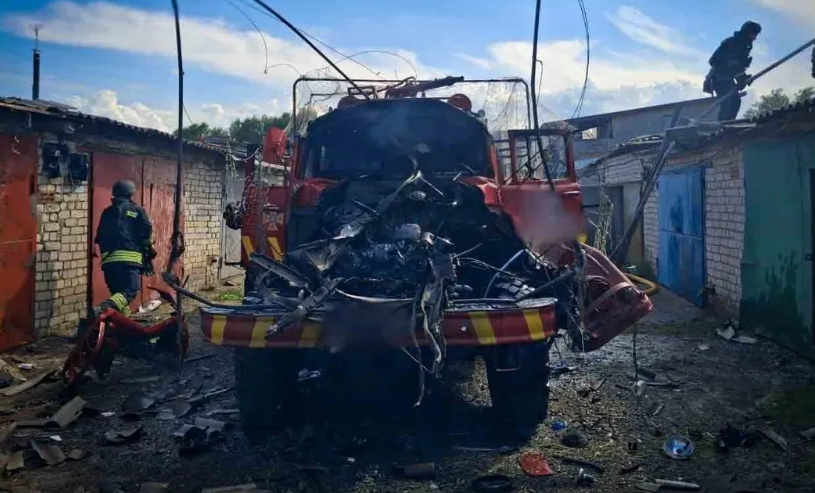
On June 7, the Russians repeatedly attacked rescuers of the State Emergency Service of Ukraine in the Glukhiv community in the Sumy region. The Russians had already used the scheme of a double strike on rescuers in Sumy – first hitting the object, then hitting again when the response services were already on the scene. This time, the aimed strike fell on a fire truck while extinguishing the fire, and then on the fire department itself. Both objects were damaged.
On the territory of the Glukhiv community, the Russians struck critical infrastructure. The first shelling caused a large-scale fire, which the State Emergency Service of Ukraine rescuers immediately set out to eliminate. However, during the extinguishing, they were forced to interrupt their work due to a repeated attack. The second shelling damaged the fire truck. Despite this, the rescuers continued their work and extinguished the fire. Fortunately, there were no casualties among the personnel.
The Russians turned the SES vehicle into scrap metal.
Later, the Russians struck the fire department itself – the equipment and the building of the unit were damaged. During the day, the Glukhiv community remained under continuous fire.
“During the day, the Glukhiv community is under Russian attacks. While the SES employees were working at the site of one of the hits, the Russians targeted a fire truck. Later, the fire department came under attack. The equipment and the building of the unit were damaged,” the report says.
The fire department was damaged.
The double-strike tactic has become a systemic threat to rescuers
Russia has begun to systematically apply the tactic of repeated strikes on Ukrainian objects. After the first hit, rescuers and emergency services arrive at the scene, and after a while the Russians strike again. This tactic turns the rescuers themselves into targets, making it impossible to properly extinguish the fires.
Rescuers are forced to suspend work and withdraw equipment due to the threat of repeated hits. In Hlukhiv, after nightly shelling, rescuers could no longer extinguish the fire until noon – the constant threat of new arrivals prevented this. Such a scheme forces the response services to operate under constant risk to their own lives.
Immediately after the arrival of the first units, there is a real threat of repeated Russian strikes on the same location. Because of this, the leadership decides to temporarily suspend work and withdraw personnel to shelter. In the Hlukhiv region, this scheme was repeated in full – and during the day the Russians also targeted the fire station.
The death of rescuers of the State Emergency Service while performing their duties in the Sumy region is not an isolated case. The service emphasizes that rescuers constantly work in a high-risk zone, eliminating the consequences of shelling. Attacks on transport and civilian cars in border communities have become a typical tactic of the Russians.
The fact of a repeated attack during the work of emergency services indicates a targeted terror tactic against civilian infrastructure. The Sumy region remains one of the most vulnerable border regions, which is systematically attacked due to its proximity to the border with Russia. Russian troops are thus trying to paralyze the work of response services and increase fear among the population.