
A contract with the devil and a lucky ticket: Colombian mercenaries captured by the Armed Forces of Ukraine told how Russia lured them into war
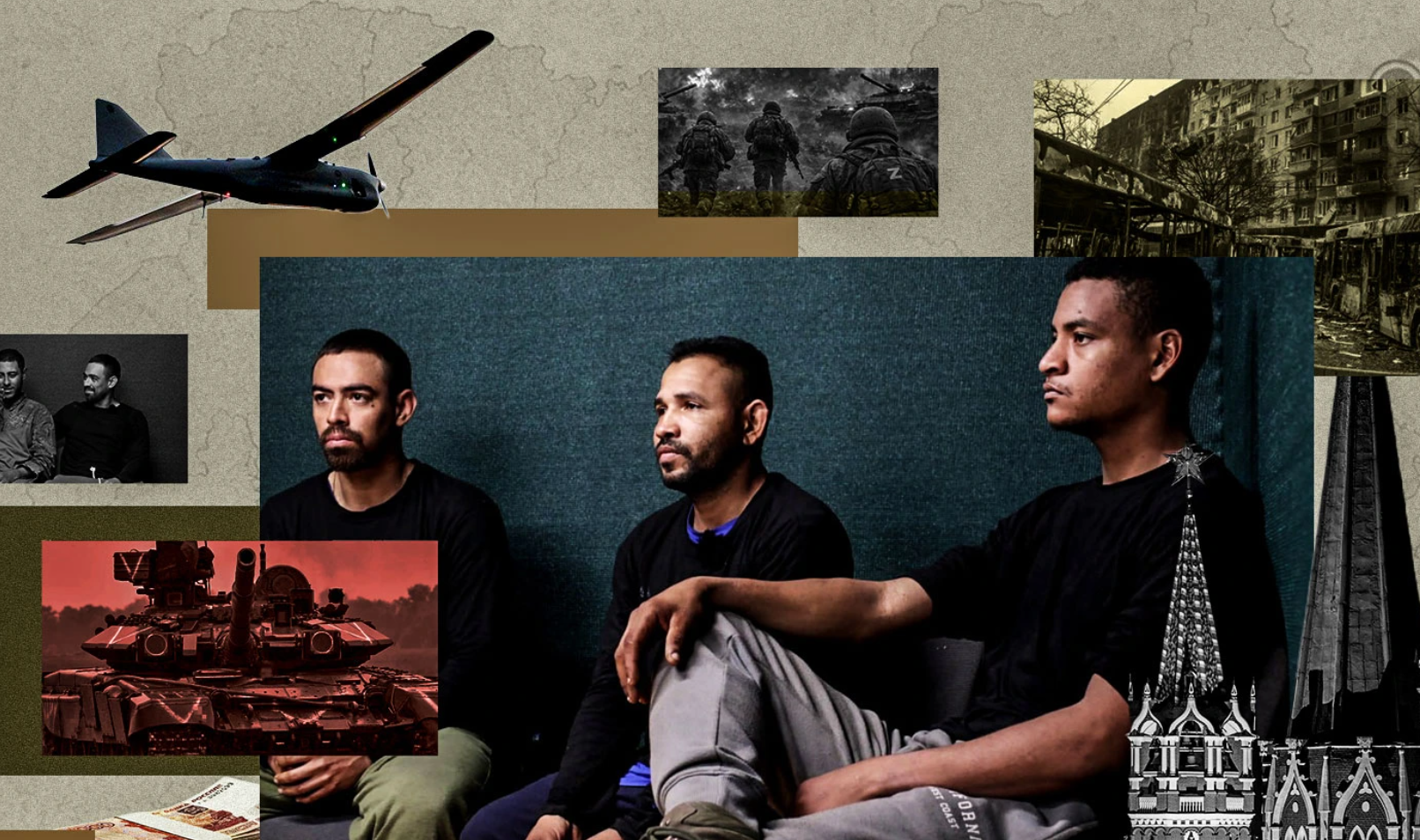
This story may seem unreal. But it is a fact – in June 2026, five Colombian mercenaries serving in the Russian occupation army surrendered to the Defense Forces. And they did it together.
They left their positions “at zero”, not wanting to wait for certain death, and went out, holding white sheets of paper with the inscription “Colombia” above their heads. They were inspired by one short phone call to this escape.
And the appearance of foreigners from distant Colombia, first in Russia, and then in Ukraine – in the ranks of the Russian occupation army, was provoked, as the Colombians themselves say, by large-scale and systematic deception.
Each of the six prisoners of war, through an interpreter, gave permission for photos, video interviews and publication. They gave several reasons why they agreed to speak to journalists. But the main one is that they were cunningly deceived in Russia. They knew that they were signing a military contract, but they claim that the recruiters promised them rear work (the same “not an assault”). But instead, the Colombians ended up in the assault as expendable material. The men believe that the Russians’ scam is not limited to them, but is systematic, literally one that envelops every Colombian who agrees to sign a contract with the Russian army.
“Russia offers SUCH an amount of money that you start to believe that you will live better.”
Diego and Leonel are brothers: Diego, the younger one, is 24 years old. The older one is 32. Together, they signed a contract with the armed forces of the Russian Federation.
The story of the war for the Colombian brothers began with Leonel. The service option found him through acquaintances.
I had a friend named Palacio, he was a professional soldier from Colombia who fought in Africa for 2 years. When he returned to Colombia, a recruiter contacted him. And this friend of mine told me that in Russia they pay 3 million rubles for signing a contract. This is just a bonus for signing a contract. And then they pay two hundred thousand rubles a month for working on military construction,” Leonel recounts the words of his acquaintance, and then the recruiter he contacted.
Three million Russian rubles is approximately 132 million Colombian pesos. This is a large sum for the average resident of Colombia. The average salary here (depending on the region and profession) is about 2.5 – 4 million pesos per month. That is, the payment for the contract reaches 82 minimum wages – this is a salary for 6 years. Depending on the city of residence, this amount will be enough either for a new car or for a small apartment.
“Fighting in Africa” – being a mercenary in Russian quasi-private military campaigns. At first it was the so-called private military company “Wagner”, and after the liquidation of its nominal Yevgeny Prigozhin, the mercenaries were reorganized into a new structure under the auspices of the Ministry of Defense of the Russian Federation. This formation was called the “Africa Corps”, which is a direct reference to the combat formation of the Nazis during the Second World War.
The brothers claim that they come from a farming family and were constantly looking for a job that would pay more. The sums promised by the Russians seemed very tempting to Diego as well.
So, he went to the recruiters with his older brother. Here’s how it went:
They offer so much money that you start to believe that you will live better. But for this you practically have to give your lives. We became cannon fodder. All this is a very big mistake because of dreams, because you wanted to escape from your situation, to move forward.
You can hear about a lucrative contract with the Russian army not only in military circles or from acquaintances, as it was with Leonel. The advertising campaign is much broader: announcements about big earnings are “poured out” on Colombians from social networks. The advertising is direct and veiled.
That’s how Kevin found the contract. He is among those prisoners who surrendered together with Leonel. Kevin Andreas Caicedo Palomino is a former soldier, worked in construction, and also went to war in search of money.
You browse Facebook, and this ad pops up. I was browsing something on my mobile phone, and an ad for a contract with good earnings appeared. There was information that it was necessary to provide security services. There is a lot of direct advertising for military service on social networks. Or various veiled invitations – programs, – Kevin tells his story.
Carlos Alberto Triana Gonzalez – a 25-year-old mechanic from the city of Santa Marta in northern Colombia – confirms the story of his brother.
His fateful ad “caught” when he was also scrolling through social networks.
One day, out of habit, I went to Facebook, an ad popped up. I ended up on the page of recruits who were looking for people for Russia. I wrote to them and went to work. Later, I received a reply, was I interested? I asked what it was about? They said you would join the Russian armed forces as a special security service and a bunker builder, and also do other jobs that they would tell you to do,” Carlos tells how he got caught by the Russian hook.
The man recalls that he made the decision to change one job for another – in distant Russia – quickly. 5 days after he saw the ad, his journey to war began.
Express delivery to war
On May 6, 2026, brothers Diego and Leonel arrived from Colombia to Russia. And in June, the brothers were already “at zero”, somewhere between the Kupyan villages and plantations, which Russia had long and several times declared captured. And in the middle of the same month, the younger one was captured by the Armed Forces of Ukraine.
The captured Colombians recall: the recruiters rushed everything – processing documents in Colombia, departure, signing a contract, training at training grounds, and finally – sending them “to the assault”.
Each of the captured mercenaries felt the same. For Carlos, a little more than a month passed between meeting with the recruiter and going on a combat mission.
On May 10, 2026, Carlos Gonzalez met the recruiter. A few days later, he was already getting a passport and buying tickets for the route “Brazil – Qatar – Russia”.
On May 16, Carlos was already in Moscow among a group of 15 foreigners like him – “seekers of easy money”. He says that the recruiters called all of them by name. On the same day, they were issued bank cards and underwent a medical examination.
On May 18, 2026, Carlos signed a contract to serve in the Russian army.
The contract was in Russian, we did not understand anything. When we signed the contract, we were given a uniform and taken to the first base for a training camp. There they were given helmets, vests and taken to the training ground. We spent about 6 days at the training ground of the first base, then the second base – we were there for 16-17 days, – mercenary Carlos tells about his “adventures” in Russia.
And already on June 16, 2026, the Colombian got into a real war.
The mission was the worst that could have happened, this is how the Colombian describes what he saw in just the first two days “at ground zero”.
Not only Colombians undergo such an “express delivery” to war.
Another prisoner from Leonel’s group – Gustavo Andreas Roa Leal – recalls that there were many men from other countries at the training bases:
What Russia does – bringing foreigners from Africa, France, Argentina, Colombia, Bolivia – it does in order to use them as cannon fodder. Because they send us to where they kill us. … “At ground zero” they send Colombians themselves, Africans, Argentines, Guatemalans, Frenchmen, – Gustavo about the barbaric tactics of the Russians, who drive deceived foreign mercenaries into virtual slavery.
Tickets for fans and an army construction contract
All six Colombians were traveling to Russia, crossing the borders of several countries. For most, this is the “Colombia – Qatar – Russia” route. Some of them had Brazil on their route. The prisoners say that they stopped by for typical legends: Leonel and Diego as tourists. Alexander and Carlos are sports fans.
However, when asked who or even what sport they were supposed to cheer for, the men do not know. They did not discuss the details with them (there was no time). They simply warned them not to say that they were going to military service in Russia. They said that they would say goodbye to their earnings, because they would turn back at the border.
The prisoners claim that Russia deceived them. Despite the fact that they knowingly signed a contract to serve in the Russian army and became soldiers. At the same time, everyone emphasizes that the recruiters promised them that they would not fight. They said that they wouldn’t have to take up arms at all.
32-year-old Leonel insists that he realized that he would only have to fight for real during training:
When we arrived at the first base and when we had to start training at the training ground. We realized that if they were training us to run in bulletproof vests, it wasn’t for building bases.
Many Colombians then realized that they had been deceived, they wanted to go back and get their money back. But they realized that they had signed a contract with the devil.
Diego served in the military in Colombia for three years, but he says that for him, being sent on a combat mission – that is, a real assault on Ukrainian positions – was a surprise.
In Colombia, they say that we will be in military service, but they don’t say that we will be where we have to kill. The contract they showed us clearly stated – “to protect”. But in reality, it’s the opposite, – says 24-year-old Diego.
The first Colombians who fought for Russia were taken prisoner in the Donetsk region back in 2025. At that time, they also convinced the Ukrainian military that their contracts did not provide for war, but only construction work.
The rest of the group of prisoners in the Kharkiv region say the same, but already in 2026.
I knew that there was a war between Russia and Ukraine. But they told us that we would not be at the front. We will be engaged in construction, repair work, says Alexander Oviedo Peña, another Colombian rescued by the Ukrainian Armed Forces.
We were told that we would not do military service, but simply work, fortify bunkers. They never said that this would be a front and that we would fight against Ukrainians, – adds Gustavo.
I understood that I had to fight when I was sent on my first mission. According to the contract, we were supposed to guard, we were never told that we would fight. Doubts arose during our training – why are we being taught this? – says Kevin.
Instead of the promised millions – a scheme to earn money from foreign soldiers
Four more foreigners arrived in Moscow along with Diego and Leonel. They joined the brothers in Bogota (the capital of Colombia). Already in Russia, a team of recruiters took care of everyone.
In Moscow, we were met by a blond man in a van. We were brought to the fire station, we slept on mattresses on the floor. We were fed. That same day, they made us bank cards – we were given 2 cards for each bank account, – says Leonel.
Then another recruiter took one of the cards from each of the foreigners who arrived. Leonel calls him “Little”. And he assumes that this man is Colombian by origin.
He left one of the two cards with PIN codes with him, took a card from each of us. He said that they would withdraw money from there: 300 thousand rubles, because he had paid for the trip from Colombia to Moscow. He said that things would be simple – we would guard. He spoke very well, – says Leonel.
The recruiters also took money, such as “for tickets”, from other mercenaries. The prisoners do not know what amounts were spent and what remained on the cards. Alexander didn’t even have a PIN code for his own card. Of the millions he received for the signed contract, he managed to spend about three thousand rubles: “They gave us our cards, but I didn’t even know the PIN code. I was just accompanying the person to buy the necessary things,” says Alexander.
Leonel and Diego are one of the few who managed to send at least some of the money to their family. The older brother describes the money scam that foreigners fall into.
Recruiters rob twice, says Leonel. “That’s their job, they earn salaries, and they rob us too. I received one million rubles. Of that million, the recruiter took three hundred thousand for tickets. I had seven hundred thousand rubles left, which I wanted to send to my family. I lost 5% because they told me that I had to exchange rubles for dollars, and then dollars for Colombian pesos. My family received 26 million Colombian pesos. This is a small amount of money compared to millions of rubles, because I lost half of it.
Some, Diego’s younger brother adds, received the money for the contract, but never saw it:
They give you money that you can’t use. I managed to send some of the money to Colombia, but my partner, who was killed by a drone, didn’t send anything. His family doesn’t even know he died.
The dead Colombian is Ever Daniel Marenco Mercado from Barranquilla (northern Colombia). According to the captive, Mercado died a day before Diego himself was captured.
Diego assumes that Daniel’s duplicate bank card is still with his recruiter.
What really awaits Colombians in the Russian army
The brothers underwent training at two training grounds. At the first one together, at the second they were separated. Diego ended up at the Sparta base. The Russians sent him on a combat mission first.
We were given a point on the map. The drones showed us the place we had to go to. There was a Ukrainian position. First, a Russian soldier led us. He brought us to a certain point, and then we, two Colombians, had to continue on our own. Orders were given over the radio through an interpreter. We didn’t even know that we had work to do there, because the interpreter didn’t give us any information. We understood that this was the front line. We were given 15 minutes to reach the hideout where the Ukrainians were. If we didn’t follow the order, they would put us in prison or the Ukrainians would kill us with drones. I understood that we might have to defend ourselves.
In his first battle, Diego was wounded, “his own people” left him. And the Colombian was captured by the Ukrainian military.
A few days after Diego went on his mission, which was his last, Leonel was sent to reinforce his brother’s group. The mercenary says that only then did he understand that they were supposed to replace the Colombians who had died earlier.
I saw dead Colombians and dead Ukrainians. It was a real meat grinder. I saw enough drones, enough dead people. We were told that in this mission we had to go forward, that there were a lot of Russians ahead. And we had to occupy an empty house. When we arrived at the starting point of the mission, we realized that it was all a lie. There was one Colombian waiting for us. He said that there was no one there, and we had to capture the village, – says Leonel.
The brothers’ words about the assaults, in which foreigners are involved, are confirmed by the rest of the prisoners. The four joined Leonel on the way to the very extreme point that they were supposed to capture. Some of them had been on the front line for a day, and some for more than ten days.
At first I didn’t know that I was in Ukraine, – says Alexander. – Little by little we began to understand where we were. As we moved forward, the dead began to appear. My “companion” (as Colombians call their compatriots who serve with them, – 24 Channel) was killed by a bomb. …It happened that we hid in a hole for seven days without food, without communication. We went out to look for food, found a package with worms, and had to eat it. God sent us rain, we collected some rainwater. It was difficult, we prayed. I had to drink my own urine. Then I met with two other comrades. And we managed to contact the Russians. They are bad people. We said that we wanted to leave, to get out. But they said to move forward, and if we did not obey the order, they would kill us. Alexander Oviedo Peña gives the name of the killed Colombian – Amesquita Hernando Jonant Arturo. He does not know whether the other “companion” – Yemison Hurtado, who was wounded, survived.
The prisoner would like their families to know what happened to both of them.
Colombians do not know the idiom “meat assaults”, which is widely used to describe Russian tactics on the front lines, but they know its equivalent – “cannon fodder”. After the Ukrainian Kupyanshchyna, where the Russians throw almost exclusively foreigners into the assaults, they call themselves that.
Rescue captivity – as the only chance to survive
The younger brother, 24-year-old Diego, who was captured earlier, says that he has already recovered and feels well. He had wounds in both legs. In the end, at the point where he was supposed to reach and capture it, eliminating the defenders, he himself was saved from blood loss by those he was supposed to kill. I was wounded in the thigh and in the shin. I put on tourniquets. I injected myself with adrenaline to survive. I had radio contact with the commander, he said to wait. The next day I realized that I had to go somewhere – either surrender or get away somewhere. … I was captured by a Ukrainian soldier, his name is Ivan. I am grateful to him for that. He took me to a trench, bandaged me, gave me food, water, a cigarette. And an hour passed, he pulled me out of this line of trees and dragged me to the position. There they treated me, gave me food. This is something I am very grateful for. I am already recovering, thanks to the help they gave me. My bones are intact, only my muscles were injured,” says Diego.
But the most important thing they did for him and his brother, Diego says, was let them call their parents. The brother passed on a message to his brother. Diego says he couldn’t call Leonel directly: he was afraid for his life:
When the Ukrainian soldiers took me prisoner, they allowed me to send a message to my parents. I had my phone with me. I asked permission to tell them that I was fine. I recorded an audio message for my father and asked him to pass on the message to his brother. I said that I was alive and that being a prisoner was the best thing that could have happened to me. I advised my brother that the best thing that could happen was to surrender.
The call from his parents found Leonel the day before his first combat mission (and possible death). So, the Colombian says, he did not go on a mission, but looked for a way and like-minded people to surrender.
I did not believe that the Ukrainians could save their lives. But it was true. My parents told me. … My father told me that this war was madness, and it would be better to surrender. At that moment, my brother was worried about me, not about himself. Because he was already out of danger. Everything looked like he was advising me to surrender, – says the rescued mercenary.
Leonel persuaded four compatriots to lay down their weapons. All four accepted that captivity was the only way for all of them to survive.
Among Leonel’s belongings was a notebook, the men tore out sheets of paper from it, wrote “Colombia” on them and raised them above their heads.
Gustavo recalls how they surrendered:
We dropped everything. We left our weapons without magazines behind us. We were accompanied by a Ukrainian drone – the Ukrainians saw that we were going to surrender. It was very good that there were Colombians themselves, that there were no Russians, because they would not have let us surrender.
For the legal entry into Russia, the recruiters bought return tickets from each prisoner. By the way, the Colombians also paid for them from their contract payments.
The ticket home, like many other things, turned out to be a fake in what they told the foreign mercenaries. The men agreed to something like tickets and entry legends about fans and tourism. In everything else, they convince us, they were deceived.
We are the victims of this deception. We are to blame for this, because we wanted money, – says Leonel at the end of the conversation.
It is symbolic that Diego and Leonel had tickets back to Colombia for June 14, 2026. On this day, the younger brother was taken prisoner. He didn’t use the ticket, but he did slip out of Russia’s hands and brought his brother out. So “lucky tickets” do exist.
But not for everyone – every day dozens of foreign mercenaries die in the fields and landings, in ruins and trenches from Ukrainian drones, artillery, bombs or missiles. Their own Russian commanders don’t stand on ceremony with them and just wait for their death. Therefore, perhaps the only reliable way to escape from this hell is Ukrainian captivity.
Source: https://24tv.ua/kolumbiytsi-poloni-zsu-yak-rosiya-zaverbuvala-yih-viynu_n3106088