
In Chernihiv region, 2,400 hectares of forest are burning near the border due to shelling from the Russian Federation
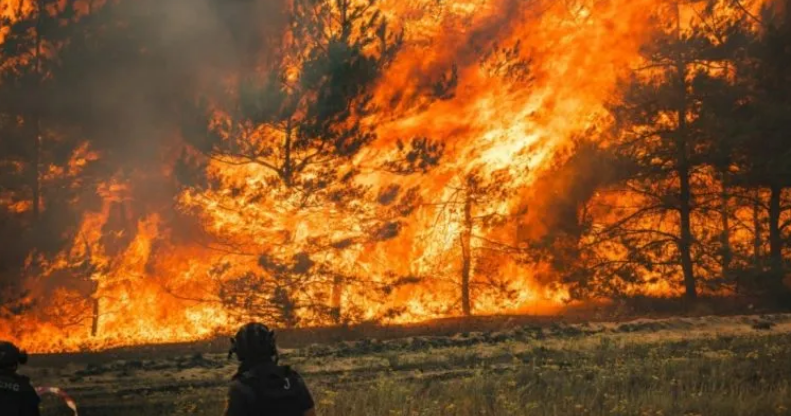
A large-scale forest fire broke out in the Chernihiv region near the border with Russia, covering 2,400 hectares of territory. The cause of the fire was massive shelling from the Russian Federation, due to which foresters are unable to reach the fire sources and organize extinguishing in the immediate border zone.
According to the state enterprise “Forests of Ukraine”, the fire is spreading to the territories of the Yelynsky and Tikhonovytsky forestry, which are part of the Koryukivskyi forest district. These areas are located in a five-kilometer border zone, where it is extremely dangerous to work on eliminating the fire due to constant shelling and the presence of Russian drones. The fires were recorded by the enterprise’s video surveillance systems.
The forest guards are trying to prevent the fire from spreading further, especially towards settlements located in the frontline zone. To do this, they are creating additional mineralized strips, and specialized equipment is working under the cover of electronic warfare, since Russian troops are firing at any vehicles that appear in the affected area. However, due to the constant threat from the air, the full use of firefighting equipment is currently impossible.
“First of all, we are creating additional mineralized strips. The company’s tractors are working under the cover of electronic warfare, because the Russians are hitting any equipment… All the company’s new firefighting equipment has been mobilized. But so far we have no opportunity to fully use it, because Russian UAVs are constantly in the air,” they say in “Forests of Ukraine”.
The Russian military regularly carries out shelling of Ukrainian cities and civilian infrastructure with various types of weapons: strike drones, missiles, guided aerial bombs and multiple rocket launchers. Such attacks lead to large-scale destruction, destruction of vital systems, and also pose a threat to the life and health of the civilian population.
The Ukrainian authorities and international organizations qualify these actions as war crimes, emphasizing their targeted nature. Shelling of life support systems, medical facilities and attempts to deprive people of access to electricity, heat, water, communications and medical care have the characteristics of genocide according to international law.
The Convention on the Prevention and Punishment of the Crime of Genocide, adopted by the UN in 1948, defines genocide as actions aimed at the total or partial destruction of a national, ethnic, racial or religious group. According to the convention, 149 member states are obliged to prevent such acts and punish the perpetrators, regardless of whether they occur in wartime or peacetime. Despite numerous facts of attacks on civilian infrastructure, the Russian leadership continues to deny the targeting of objects that provide life for the population of Ukraine, and denies civilian casualties.