
Oil blackmail: why Orban and Fico launched a campaign against Ukraine and the EU
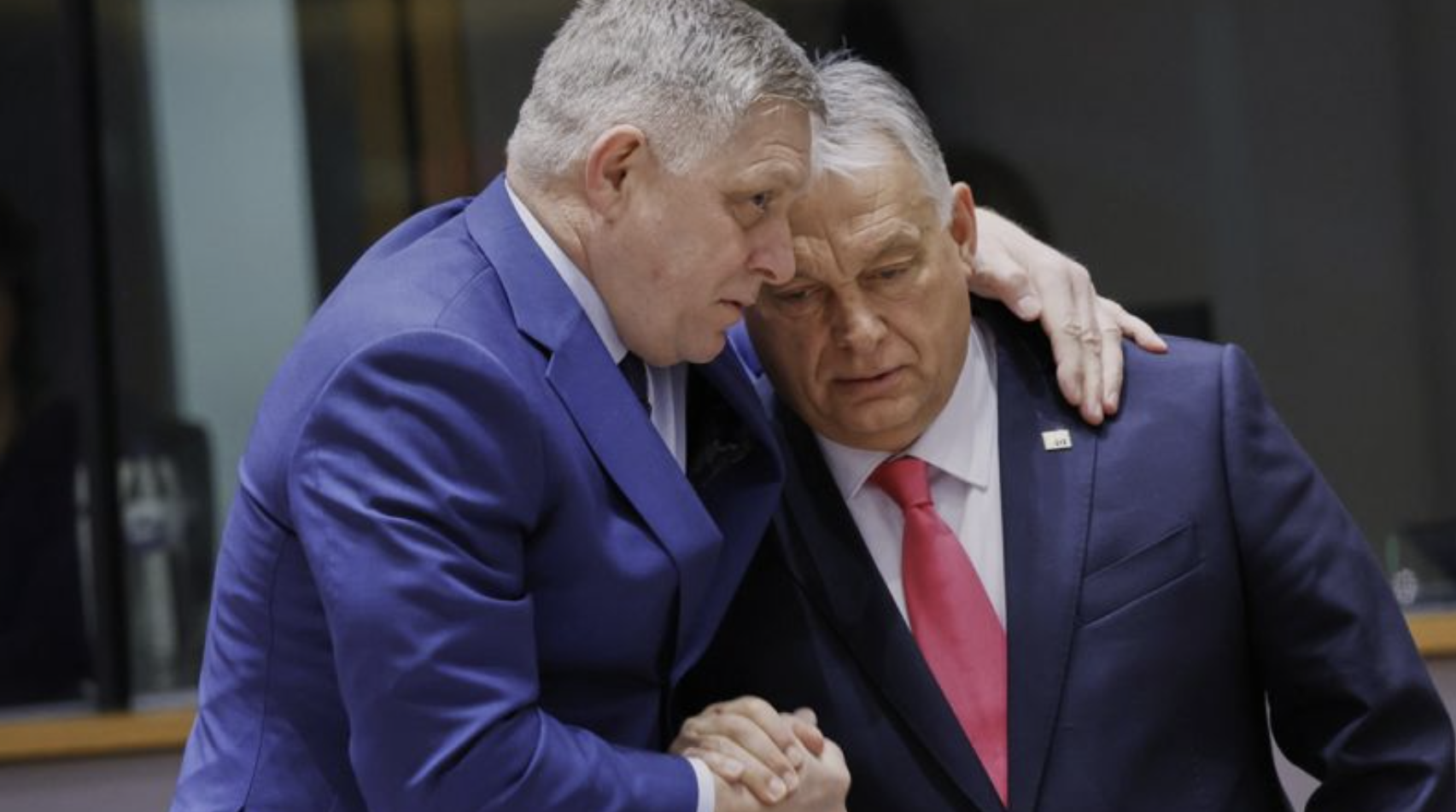
Two months before the elections, Hungarian Prime Minister Viktor Orban went all-in and launched an anti-Ukrainian campaign, blocking EU aid packages to Kyiv and the adoption of sanctions against Moscow. And Slovak Prime Minister Robert Fico, after a telephone conversation with President Volodymyr Zelenskyі, stated that Ukraine was allegedly not interested in resuming the Druzhba oil pipeline to continue the transit of Russian oil. Why Orban and Fico continue to blackmail Ukraine and the European Union.
Following a telephone conversation with his Slovak counterpart Robert Fico, Viktor Orban said that their countries would create an investigative commission to assess the condition of the Druzhba pipeline. Orban called on Ukrainian President Volodymyr Zelenskyі to grant Hungarian and Slovak inspectors access to the Druzhba oil pipeline and to immediately resume its operation.
“We will create a joint investigative commission, and the task of this commission will be to go to the scene of the incident and see the reality. I call on President Zelenskyі to allow this investigative commission to arrive at the scene and provide the necessary conditions for its work,” Viktor Orban said.
The Hungarian Prime Minister also accused Ukraine of an oil blockade and said that if there is no oil from Russia, it will lead to economic chaos in his country. And the head of the Slovak government, Robert Fico, said that according to his information, the Druzhba pipeline can supposedly function from a technical point of view.
“The Ukrainian side is trying to launch a campaign aimed at achieving Ukraine’s goal, which is to make it technologically impossible to deliver oil to the Slovak Republic through its territory. The oil that the Slovnaft joint-stock company buys on the Belarusian-Ukrainian border is no longer the transit of Russian oil, but the transit of oil that is already owned by the Slovnaft oil refinery,” Fico stressed.
The supply of Russian oil to Slovakia and Hungary via the Druzhba oil pipeline stopped at the end of January 2026 after Russia attacked Brody in the Lviv region. The fire there was extinguished within several days. Despite this, the governments of Slovakia and Hungary simultaneously decided to declare a state of emergency on the oil products market in their countries. Both countries stated that Ukraine was deliberately not repairing the pipeline because it did not want to supply them with Russian oil. Now Orban promises to block all EU decisions on aid to Ukraine until Kiev restores oil flows through its territory.
“Orban’s vicious attacks on Kyiv were part of his tactics even before Russia’s full-scale invasion, based on historical grievances and Budapest’s ties with Moscow. He has recently redoubled his efforts, criticizing Ukraine and its EU backers, calling them warmongers who seek to cut off energy supplies to Hungary, and promising to save the country from war,” the publication writes.
The situation with Russian oil supplies to Hungary and Slovakia does not pose a threat to the European Union. Both countries have an alternative oil supply route, the European Commission said.
“At this stage, there is no immediate threat to the security of supply in the EU. Both Hungary and Slovakia have oil reserves. Secondly, there is an alternative supply route that could be used by Hungary and Slovakia. And that is the Adria pipeline from Croatia. Croatia confirmed at the meeting that non-Russian oil is being transported via the Adria pipeline to Hungary and Slovakia,” said Anna-Kaissa Itkonen, a spokeswoman for the European Commission on energy.
However, Hungary has already blocked the agreed EU loan for Ukraine of 90 billion euros and is blocking the adoption of the 20th package of European Union sanctions against Russia. The position of the Hungarian and Slovak authorities on the war differs from that of most EU countries, experts say. They do not support Ukraine militarily and insist on concluding peace as soon as possible, including through concessions from Kyiv. Hungary is also categorically against Ukraine’s membership in the EU. All this contributes to reviewing the current principles of the European Union, said European Commissioner for Enlargement Marta Kos.
“We do not need Orban to tell you what the requirements are for joining the EU. And you do not need Orban to do this either. We live in a reality where there is no longer an international order, where the US, China and Russia are guided by the logic of spheres of influence. For the first time, we have encountered the fact that there are external opponents of EU enlargement who want the failure of both our candidates, for example, Ukraine, and the failure of the entire European Union. Therefore, we are looking for an opportunity to change our enlargement rules, the so-called methodology, so that it meets real challenges,” she noted.
Hungary and Slovakia are endangering the alliances they are obliged to protect with their actions, and are doing so openly in favor of Putin for cheap energy and not only. In this way, they are facilitating the Russian Federation in its provocations against the European Union.