
Ukraine’s Foreign Ministry accuses Hungary of abusing Oschadbank cashiers
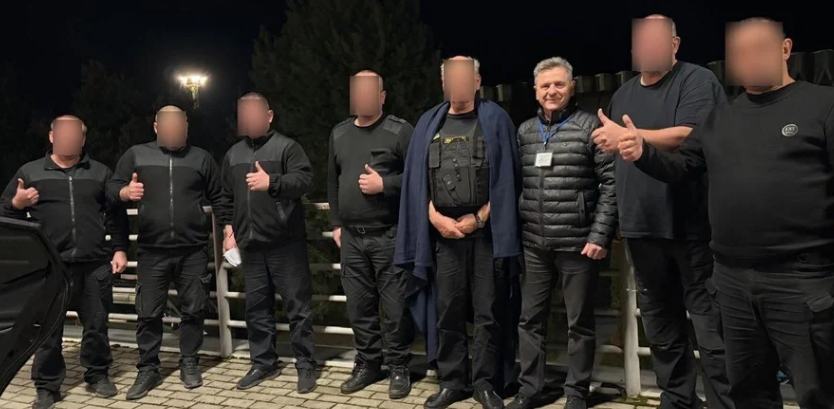
The Ukrainian Foreign Ministry said that while the Oschadbank cashiers were being held in Hungary, they were being treated roughly.
According to the statement from the Foreign Ministry, Budapest knew that the cashiers were not armed, but still detained the Ukrainians with the help of the Anti-Terrorism Center fighters who had machine guns and grenade launchers.
Although the detainees had the status of witnesses, they were held in handcuffs for 28 hours and transported blindfolded the entire time, the ministry reported. The Ukrainians were also taken away with personal belongings, including mobile phones, which were never returned.
According to the Foreign Ministry, when the health of one of the detainees, who has a disability and requires a special diet and regular medication, deteriorated, medical assistance was provided only after he lost consciousness.
At the same time, a Ukrainian man with diabetes was forcibly injected with a drug, after which his blood sugar level rose sharply and hypertension began. He was later hospitalized.
The Foreign Ministry noted that psychological and physical pressure was exerted on the detainees. They were also not allowed to testify in Ukrainian, communicating with them in Russian. Oschadbank employees were not allowed to use legal protection, and they were also prevented from meeting with the Ukrainian consul.
The Ministry noted that employees of the Hungarian services involved either avoided communicating with representatives of the Ukrainian embassy or provided false information about the whereabouts of the detainees.
Although there was no evidence of the Ukrainians’ involvement in illegal actions and they had the status of witnesses all the time, Hungary decided to deport them and impose a 3-year ban on entry to the Schengen area. The Foreign Ministry says that this looks like punishment for Ukrainians who did not provide the necessary evidence to the Hungarian side.
The Foreign Ministry considers such actions of Budapest to be “unacceptable and inadequate”, which are a cynical violation of a number of provisions of the European Convention on Human Rights, the Vienna Convention on Consular Relations and the Ukrainian-Hungarian Consular Convention.
It also emphasized that the cargo transported from Austria to Ukraine via Hungary was registered in accordance with international transportation rules and current European customs procedures.
“We also recall the demand to immediately return the stolen vehicles of the Ukrainian state bank and the valuables that were transported. We emphasize the unacceptability of such arbitrary actions, which can be equated to hostage-taking and theft of property. We insist on the need for a decisive response at the European level to this state banditry,” the ministry added.
On the night of March 6, it became known that Hungary had unjustifiably detained two cars of the Sberbank collection service and seven Ukrainian citizens, employees of the collection team. The Ukrainians regularly transported foreign currency and bank metals between Raiffeisen Bank Austria and Sberbank Ukraine. The cars were carrying $40 million, €35 million and 9 kg of gold.
Later, the National Tax and Customs Administration of Hungary stated that it suspects the Ukrainians of “money laundering”. The Hungarian authorities also announced their intention to deport the Ukrainian collectors from the country.
Sberbank later confirmed that all seven collectors detained in Hungary had returned to Ukraine and were receiving the necessary support, and the bank continues to investigate the circumstances of the incident.
Ukrainian Foreign Minister Andriy Sybiga stated that the detention of the Sberbank collectors in Hungary was being viewed as a possible Russian provocation. He also called on Hungary to return the currency and gold bars that were seized from the collection cars of Oschadbank Ukraina.